The Faverolles: Five Toes, a Beard and the Gentlest Temperament
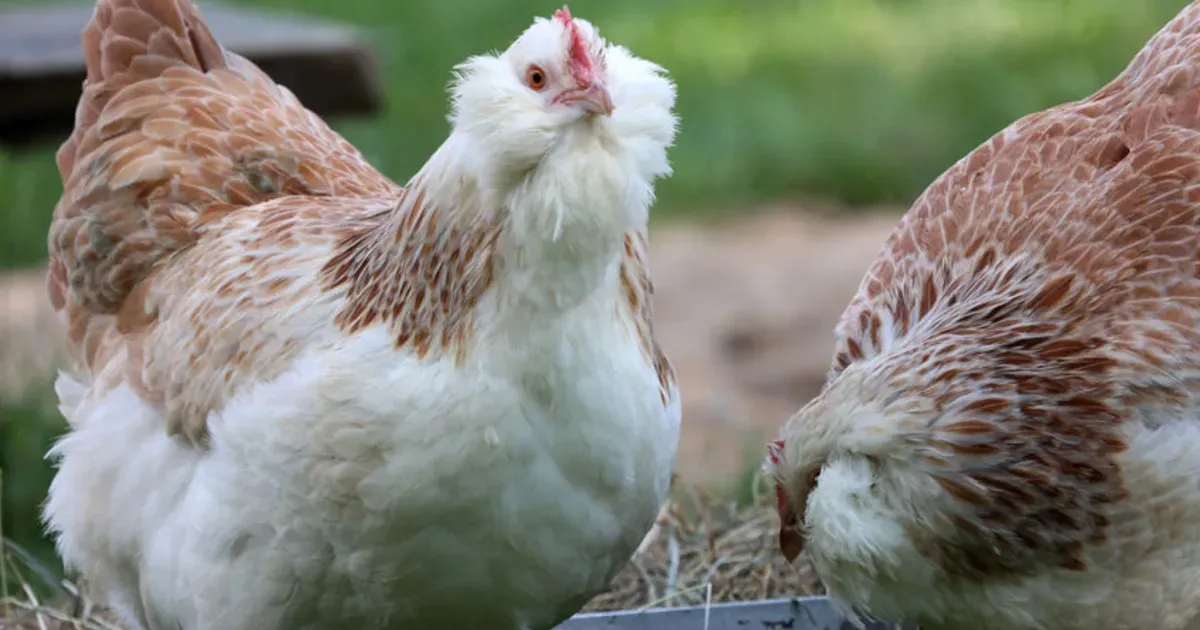
The Faverolles is one of the most peculiar-looking birds in poultry: it has a thick beard and muffs framing its face, lightly feathered legs, and — where most chickens have four toes — five toes.
But what really sets the Faverolles apart is its temperament: it is perhaps the gentlest and most affectionate of all chicken breeds. It climbs into your lap, learns its name and follows children about. In this guide we cover the breed's origin, the genetic story behind those five toes, the particular care problem its beard creates, and its risk of being bullied in a mixed flock.
Origin: Created for the Paris Market
The Faverolles comes from the French village of Faverolles. Its creation in the late 1800s had an entirely concrete purpose: the Paris market needed a farm bird supplying both meat and eggs.
Houdan, Dorking, Brahma, Cochin and Crèvecœur were blended together. The result: a large-bodied, winter-hardy bird with fine meat and steady laying. Its meat is still prized in French cooking.
- Cock: 3.6 – 4.5 kg
- Hen: 2.9 – 3.5 kg
- Varieties: Salmon is the famous one; white, black, blue and buff also exist
- Distinguishing marks: beard and muffs, lightly feathered legs, five toes
Five Toes: A Rare Club
A normal chicken has four toes. Five toes (polydactyly) appear in only a handful of breeds and are one of the markers of pure stock:
| Five-toed breeds | Origin |
|---|---|
| Faverolles | France |
| Silkie | Asia |
| Dorking | England |
| Houdan | France |
| Sultan | Ottoman Turkey |
The Faverolles gets its fifth toe from the Dorking and Houdan in its make-up. If you're buying Faverolles chicks, count the toes — a four-toed bird isn't pure.
Output in Numbers
| Trait | Value |
|---|---|
| Point of lay | 5-6 months |
| Eggs per year | 150-200 |
| Egg weight | 55-60 g |
| Egg colour | Cream / light pinkish brown |
| Daily feed intake | 130-150 g (a large body) |
| Winter eggs | Yes, it lays through winter |
Output is moderate, but it carries one advantage: as we explained in our Barnevelder guide, most breeds stop laying in winter — the Faverolles doesn't. Dense feathering and a big body hold its heat, so it can spend energy on eggs.
Temperament: The Risk of Being Too Nice
Among poultry keepers the Faverolles is known as "the friendliest breed". Calm, curious and affectionate, it likes being picked up and gets on famously with children — ideal for family and hobby keeping.
But that gentleness has a cost. The problem we set out in our Orpington guide applies here as well: in a mixed flock it gets bullied. Dominant breeds — the Wyandotte, the RIR, the Leghorn — keep it off the feeder and pull the feathers out of its beard.
The practical rule: keep Faverolles with calm breeds such as the Orpington, the Brahma, the Cochin or the Australorp. If trouble starts, extra feeders and drinkers are the first fix; the detail is in our guide to pecking and cannibalism.
Special Care: The Beard Hides Lice
This is a Faverolles-specific point that is often neglected. The dense beard and muffs around the face are a perfect hiding place for lice and mites. On an ordinary chicken the head is relatively exposed; on a Faverolles there is a thick cushion of feathers.
- Check the beard area regularly — part the feathers and look at the skin; lice and their eggs (nits) show up at the feather bases
- Don't skip external parasite treatment (every three months)
- The beard feathers get caked in drinking water and feed; a deep, narrow-mouthed drinker keeps them clean
- Its lightly feathered legs, as with the Brahma and the Cochin, are prone to fungus and scaly leg mite in mud — the floor must be dry
For the general parasite and hygiene rules, see our coop biosecurity guide.
Chick Sexing in the Salmon Variety
The commonest colour of the Faverolles is the Salmon, and in this variety the sexes are completely different in colour:
- Hens: salmon and cream tones — light and soft
- Cocks: black, white and straw in sharp contrast — markedly darker
The difference shows in the chick down too: pullets are lighter and plainer, cockerels darker and more contrasted. It isn't infallible, but an experienced eye can call it early — along with the Welsummer it is one of the few pure breeds in which sex can be read early. For detail see our guide on how to tell a chick's sex.
Care and Housing
- Coop space: 0.4-0.5 m² per hen (a large body)
- Run: 2-3 m²; it tolerates confinement
- Flying: heavy and barely flies; a 1-1.5 m fence is enough
- Perch: mid-to-low (40-50 cm) — a heavy bird
- Floor: dry (feathered legs)
- Cold: copes well; lays through winter
- Heat: dense feathering is a burden in summer; shade and cool water are needed
For coop dimensions see our guide on how to build a chicken coop.
Hatching
The Faverolles goes broody moderately and makes a good mother. It isn't as dependable a broody as the Silkie or the Cochin, but nor is it a zero like the Leghorn. For natural incubation see our guide to hatching with a broody hen.
In an incubator the period is standard: 21 days, 37.5-37.8 °C, 45-55% humidity, lockdown on day 18. The cream, pale shell makes candling straightforward — an advantage over the Marans' dark shell.
We set out the process in our 21-day incubation guide; to keep the days straight, the Kuluçka Takip app builds the calendar and reminds you of turning and hatch days. You can check out the app here.
A breeding note: the Faverolles is a pure breed. The five toes and the beard are easily lost in a cross, so use pure-line stock — and count the chicks' toes.
Pros and Cons
- + Among the gentlest and most affectionate of chickens; ideal with children
- + Lays through the winter (150-200 a year)
- + Dual purpose: a large body and meat prized in France
- + Five toes, beard and feathered legs: a striking bird with show value
- + In the Salmon variety, chick sex can be guessed early
- + Tolerates confinement; cold-hardy
- + A pure breed: you can hatch your own chicks
- − Gets bullied in a mixed flock — don't keep it with dominant breeds
- − The beard hides lice and mites; regular checks are essential
- − Feathered legs: the floor must be dry
- − Moderate egg output; poor in heat
Who Is It For?
The Faverolles suits you if: you have children and want a hen that can be handled and cuddled; you want eggs through winter; you want meat as well as eggs; you like an unusual, striking bird; your flock is made up of calm breeds.
The Faverolles is not for you if: your flock contains dominant breeds (it gets bullied); you want maximum eggs → the Lohmann or the Leghorn; you want a guaranteed broody → the Silkie or the Cochin; you live in a hot climate; or you can't commit to regular parasite checks (the beard needs them).
To compare all the breeds side by side, see our guide to choosing a laying or meat breed.
Frequently Asked Questions
How many toes does a Faverolles have?
Five. Normal chickens have four; five toes appear only in a few breeds — the Faverolles, the Silkie, the Dorking, the Houdan and the Sultan. A four-toed Faverolles is not pure.
How many eggs does a Faverolles lay per year?
It lays 150-200 cream to pale pinkish eggs a year (55-60 g). Its great advantage is that, unlike most breeds, it keeps laying through the winter.
What is the Faverolles’ temperament like?
It is among the gentlest and most affectionate of all chickens; it likes being picked up and is superb with children. But that same gentleness means it gets bullied in a mixed flock by dominant breeds (Wyandotte, RIR, Leghorn).
Why does the Faverolles’ beard need special care?
The dense beard and muffs around the face are an ideal hiding place for lice and mites. Part the feathers and check the skin regularly, and treat for external parasites every three months.
Can Salmon Faverolles chicks be sexed?
Largely, yes. In the Salmon variety the hens are light salmon and cream while the cocks are dark, in contrasting black and white. The difference shows in the chick down too; it isn’t infallible, but an experienced eye can call it early.
Which breeds should Faverolles be kept with?
With calm breeds such as the Orpington, the Brahma, the Cochin or the Australorp. Kept with dominant breeds like the Wyandotte, the RIR or the Leghorn, it is driven off the feeder and its beard feathers get pulled out.
How big is a Faverolles?
Cocks reach 3.6-4.5 kg and hens 2.9-3.5 kg. Its large body makes it a dual-purpose breed whose meat is prized in France.
Related Articles
Budgerigar Colour Mutations: The Genetics and Predicting Chick Colour
We explain the budgerigar's dozens of mutations, all derived from one wild colour (green), through three inheritance rules: recessive (blue series, the 'split' idea), dominant (grey, spangle) and sex-linked (lutino/albino, cinnamon, opaline). Reading sex from colour thanks to the ZW sex chromosome, the dark-factor table, and the health risk of inbreeding for colour.
Keeping Peafowl: The Train, Three Years of Patience and Blackhead
The peacock’s famous fan is not a tail but the train — elongated upper tail coverts — and it is moulted every year, so the bird never needs plucking. The cock’s train takes three years and the hen’s first egg two; the call carries over a kilometre; and peafowl raised on chicken ground die of blackhead.
Emu and Rhea Farming: The Male Does the Incubating
The ostrich’s two cousins, two different businesses: the emu’s money is in oil (6-10 litres), the rhea’s in meat. All three share one oddity — the male incubates. A male emu barely leaves the nest for 50-56 days, eating and drinking nothing and losing up to a third of his body weight; a male rhea alone incubates the 10-60 eggs that several females lay in his single nest. The toe table: two in the ostrich, three in the emu and rhea, four in a hen, five in the Faverolles.