How to Hatch Chicken Eggs in an Incubator: A 21-Day Step-by-Step Guide
You've bought an incubator and you're ready to set your first eggs. But putting the eggs in and pressing the button is only the beginning. A successful hatch comes from managing temperature, humidity and turning correctly over 21 days. In this guide we walk through the whole process day by day, from preparation before setting the eggs to the chick pipping the shell.
How Long Does Incubation Take?
A chicken egg's incubation period is 21 days. The first 18 days are the "development period" and the last 3 days the "hatch period". The settings for these two periods differ; the most common mistake is forgetting to change the settings for the final 3 days.
Other poultry have different durations; this guide is for chickens, but for comparison:
| Poultry | Incubation period |
|---|---|
| Chicken | 21 days |
| Quail | 17-18 days |
| Duck | 28 days |
| Turkey | 28 days |
| Goose | 30-32 days |
Step 1: Preparation Before Incubation
The single most important factor in your hatch rate is the quality of the eggs you set. A bad egg won't give a good result.
Choosing eggs:
- Choose clean, crack-free, normally shaped eggs. Discard very large, very small or double-yolk eggs.
- Don't wash the eggs. Washing removes the natural protective layer (cuticle) on the shell and lets microbes in. If lightly soiled, wipe with a dry cloth.
Resting the eggs:
- Before setting collected eggs, rest them pointed-end down for 12-24 hours at room temperature. This lets the air cell settle into place.
- The fresher the egg, the better. Hatch rates drop noticeably for eggs older than 7 days.
Calibrating the machine:
- Run the incubator at least 24 hours before setting the eggs. Make sure the temperature and humidity have stabilised at your target values.
- Don't blindly trust the machine's own display. Verify with a separate digital thermometer/hygrometer. On cheap machines the display and the real value can differ by 1-2 degrees, and that difference can ruin the hatch entirely.
Step 2: The Right Temperature
Temperature is the most critical incubation parameter. Even half a degree off affects the result.
- Forced-air (fan) machines: 37.5 – 37.8 °C
- Still-air (static) machines: 38.0 – 38.5 °C (measured at egg level, because in a still-air machine the top is hotter)
Most home machines are forced-air, so your target is around 37.7 °C.
Watch out for:
- Too hot and chicks hatch early and weak, with more deformities.
- Too cold and the hatch is delayed; chicks hatch late and listless.
- A short (a few hours) power cut is not a disaster. Keep the lid closed; the machine holds its heat for a while.
Step 3: The Right Humidity
Humidity is as critical as temperature but more forgiving. It splits into two periods:
- Days 1–18 (development period): 50%–55% humidity
- Days 19–21 (hatch period): 65%–70% humidity
The point of humidity is to make the water inside the egg evaporate at the right rate. During development the air cell should grow slowly; during the hatch period high humidity softens the shell and lets the chick come out without sticking to it.
How to set humidity: by filling the water trays in the machine. More water surface = more humidity. During the hatch period, fill the extra trays or add a wet sponge.
Step 4: Turning the Eggs
Eggs are turned regularly to stop the embryo sticking to the shell.
- How often: At least 3-5 times a day. An odd number is preferred (3, 5) so the egg rests on a different side each night.
- Until when: Stop turning completely at the end of day 18. After this the chick starts getting into hatch position; turning harms it.
- If your machine has an auto-turner: it does the work. Still, don't forget to switch off the turning motor on day 18.
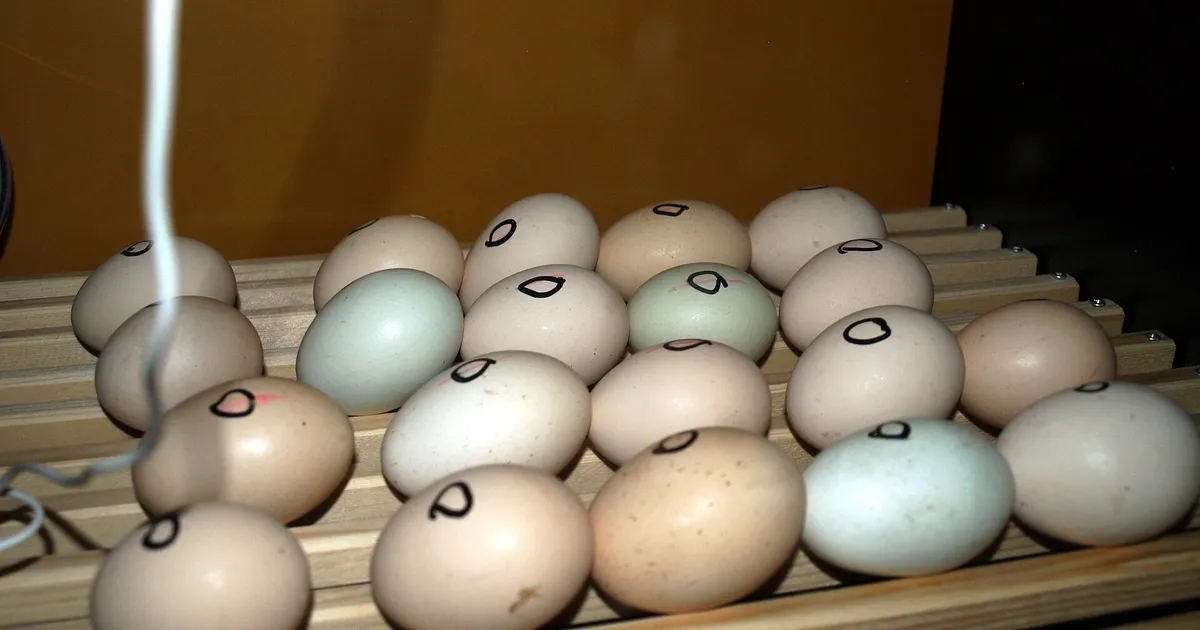
- If you turn by hand: mark an "X" on one side and an "O" on the other with a pencil so you don't lose track of which you've turned.
Step 5: Candling (Egg Check)
The 21-Day Incubation Calendar (Day by Day)
If you want to see the whole chicken incubation at a glance, this calendar sums up what to do on each day:
| Day | What happens / what you do |
|---|---|
| 0 | Run and calibrate the incubator 24 hours ahead; set the eggs, temperature 37.5-37.8 °C, humidity 45-55%. |
| 1-6 | The heart starts beating on day 2 and the vein network forms. Turn 3-5 times a day; don't open the lid needlessly. |
| 7 | First candling. A fertile egg shows spider-web veins and a dark spot (the embryo). Remove the clear ones. |
| 8-13 | Feather follicles and the beak form. Keep turning; watch the air cell growing. |
| 14 | Second candling. Most of the egg should be dark and the air cell clearly defined. Remove any that stopped developing. |
| 15-17 | The chick moves into hatching position (head towards the air cell). The last turning days. |
| 18 | Lockdown. Stop turning, raise humidity to 65-70%, and don't open the lid again. |
| 19-20 | The chick pierces the inner membrane (internal pip) and you may hear cheeping. The first crack (external pip) appears. |
| 21 | Hatch. The chick cuts around the shell and pushes out. Don't take it from the incubator until it's dry. |
| 22-23 | Give late eggs two more days, then assess the ones that didn't hatch. |
To avoid missing what to do on each day, the Kuluçka Takip app sets this calendar automatically for your species and reminds you of the critical days.
Candling means holding a strong light under the egg in a dark room to see inside. It lets you track development and remove empty/dead eggs.
- Day 7: A network of veins and a small dark embryo are visible. Eggs that stay fully clear are infertile — remove them. Eggs showing a blood ring died early — remove those too.
- Day 14: Most of the egg should have darkened, with the air cell clear at the top.
- Day 18: Final check. Don't touch the eggs after this.
Removing empty and dead eggs matters: they spoil and burst inside, contaminating the other eggs.
Step 6: The Hatch Period (Last 3 Days)
From day 19 things change. This period is also called "lockdown":
- Stop turning (at the end of day 18).
- Raise humidity to 65-70%.
- Don't open the lid. This is the biggest mistake. When you open the lid out of curiosity the humidity drops suddenly, the membrane shrinks onto the chick ("shrink wrap"), and the chick dies before it can hatch.
- Once chicks start breaking the shell (pip), be patient. It can take a chick 12-24 hours to break out completely. Don't intervene; helping usually does harm.
After hatching, chicks can stay in the machine until their down dries (6-12 hours). Once dry and lively, move them to a heated brooder.
The Most Common Mistakes
- Trusting the machine's display. Always use an external thermometer/hygrometer.
- Opening the lid during the hatch period. Humidity escapes and the chick sticks to the shell.
- Forgetting to stop turning on day 18.
- Washing the eggs. It destroys the protective layer.
- Trying to track the process in your head. Which setting on which day, when turning stops, when humidity rises — these are hard to remember, and slipping up one day can risk the whole batch.
That last point is exactly why we built the Kuluçka Takip app: it automatically reminds you which day you're on, when to stop turning, when to raise humidity and the estimated hatch day. If you're running several batches you track each one separately. You can check out the app here.
If you follow the steps in this guide in order, you can get a high hatch rate on your first try. The three most critical rules: the right temperature, the right humidity, and not opening the lid during the hatch period. Get those three right and the rest largely takes care of itself.
Sources and verification
Technical values in this article were checked against the university extension sources below. Species- and model-specific instructions from your equipment manufacturer take priority.
- Hatching Quality Chicks — Mississippi State University Extension · accessed 2026-07-26
- The Avian Embryo — Mississippi State University Extension · accessed 2026-07-26
Frequently Asked Questions
How many days does a chicken egg take to hatch?
A chicken egg hatches in 21 days. The first 18 days are development and the last 3 are the hatch period.
What temperature should an incubator be?
37.5-37.8 °C in forced-air machines, and 38.0-38.5 °C measured at egg level in still-air machines.
What humidity is needed for incubation?
Use the machine manual as the starting target; institutional guides give roughly 50-60% for the first 18 days and at least 65% for the last three. Adjust by checking air-cell growth on days 7, 14 and 18.
How many times a day are eggs turned?
At least 3-5 times a day, an odd number. Turning is stopped completely after day 18.
The chick has pipped but can't get out — should I help?
Usually no. Hatching can take 12-24 hours. Early intervention harms the chick. But if it has been more than 24 hours and the humidity is right, it can be assessed very carefully.
Will the eggs die if the power goes out?
Not in short outages. Keep the lid closed; the machine holds heat for a while. In long outages, wrapping the eggs in a blanket slows heat loss.
Related Articles
How to Recognize a Broody Hen: The Guide to Hatching Chicks Naturally
How to recognize a broody hen, how many eggs to set under her and how to manage 21 days of natural incubation. Nest setup, post-hatch care and incubator comparison.
How Many Days Is Turkey Incubation? Temperature, Humidity and Poult Care Guide
Turkey incubation takes 28 days. The complete turkey incubation guide: temperature, humidity, egg turning, the hatch period and poult care, step by step.
How Many Days Is Quail Incubation? Temperature, Humidity and Hatch Guide
Quail incubation takes 17-18 days. The complete quail incubation guide explaining temperature, humidity, egg turning and hatch-period settings step by step.