Lovebird Colour Mutations: Blue Is Not One Thing (Parblue)
The lovebird (Agapornis) is the fourth species in our colour-mutation series. The three inheritance rules (recessive, dominant, sex-linked) that we set out in the budgerigar, cockatiel and canary articles apply here too. But the lovebird adds two new lessons: (1) blue is no longer a simple "present/absent" but a series of several versions (alleles) of the same locus; and (2) in the lovebird the question of species comes to the fore — because Agapornis is not one species but a group of species that can interbreed.
The Starting Point: Wild Colour and the Species
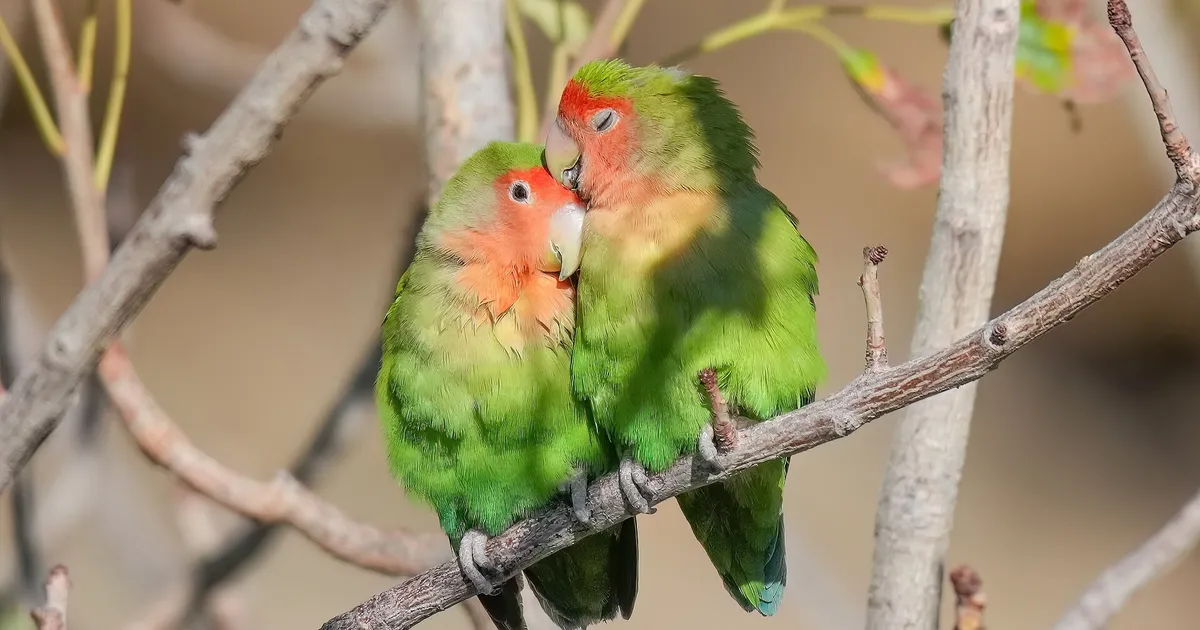
The most common lovebird is the peach-faced (Agapornis roseicollis): its wild colour is a green body with a peach-pink face. The great majority of mutations are in this species. There is also the eye-ring group (Fischer's, masked/personatus): they carry a white ring around the eye and have their own separate sets of mutations.
This distinction matters, because the name of a mutation in one species may not be identical in another; and, as you will see below, there is a serious drawback to mixing the species.
Lovebird Mutations by the Three Rules
We explained how the inheritance rules work in our budgerigar mutations article. The peach-faced lovebird's main mutations fall out like this:
| Inheritance | Mutations |
|---|---|
| Sex-linked | Lutino, cinnamon, opaline, pallid (an ino relative) |
| Recessive | Dilute, orange-face, dark-eyed clear, fallow |
| Dominant / semi-dominant | Dark factor, violet factor, dominant pied |
New Lesson 1: Blue Is Not One Thing — the Parblue Series
In the budgerigar, blue was a simple recessive: it was either there (blue) or not (green). In the lovebird a single locus, the "blue locus", carries several alleles (versions) — this is called the parblue (partial-blue) series. The three main versions:
- Blue: the version that removes the most yellow
- Aqua: leaves some of the yellow → a cool greenish tone
- Turquoise: leaves even more yellow → a bright turquoise tone
These are not separate genes but different versions of the same locus; and a bird can carry two of these versions at once (for example aqua/turquoise), in which case the colour comes out somewhere between the two. So you step up from the budgerigar's "present/absent" logic: here it is which two alleles come together that sets the colour.
A practical warning: in the market the names "aqua" and "turquoise" are sometimes confused. You can only know a bird's true genotype safely from its pedigree and its chicks — just as with the "split" idea in the budgerigar.
Face Colour and Opaline
The peach-faced lovebird's signature is the reddish colour of its face. The opaline (sex-linked) mutation spreads this colour towards the body and changes the pattern. Orange-face (recessive) turns the red of the face to orange. When these two mutations combine with the parblue series, a great many commercial "colour" names appear — but all of them are just a few genes stacked (the same combination logic as in the cockatiel).
New Lesson 2: Do Not Mix the Species
This is the lovebird's most important matter of responsibility. Agapornis is several separate species (peach-faced, Fischer's, masked, Nyasa, black-cheeked…). These species can interbreed and often produce fertile hybrids. Unlike the sterile mulard in ducks, these hybrids can reproduce, so they can irreversibly spoil pure species lines.
So the rule of responsible breeding is clear: do not breed different Agapornis species together. A hybrid bird may look pretty, but it pollutes the genetic integrity of a pure species; and for threatened species such as the black-cheeked, it even makes conservation in the wild harder. Mutation work should always be carried out within a single species.
Sexing the Lovebird
In the peach-faced lovebird the cock and hen look almost identical (visual dimorphism is very weak); the surest method is a DNA test. As a behavioural clue, hens tuck nesting material into the feathers of the rump to carry it. If you use a sex-linked mutation (lutino, cinnamon, opaline), you can also read sex from colour by the auto-sexing logic seen in the budgerigar. For the chicken counterpart of the same ZW system, see our how to sex chicks article.
The Dark Factor
As in the budgerigar and cockatiel, the dark factor is semi-dominant in the lovebird: on green, one copy gives dark green and two copies olive. The same factor rides on top of the parblue series, taking blue into cobalt and mauve tones — so part of the colour range is born of the parblue series multiplied by the dark factor.
For Beginners
- Start with a clean recessive (dilute) or a sex-linked (lutino): these are the mutations whose inheritance is easiest to read.
- Understand the parblue series before buying a bird labelled "blue/aqua/turquoise": otherwise the tone you expect may not appear.
- Stay within one species: never breed different Agapornis species together.
You will find the incubation and nesting process in our cage-bird incubation article, and the logic of breeding selection and pedigree in our cage-bird breeding article. To keep the mating–laying–hatch calendar straight, the Kuluçka Takip app sets reminders. You can take a look at the app here.
The other articles in the series: budgerigar, cockatiel and canary colour mutations. Reading the four species side by side shows how the same three inheritance rules put on different faces in different birds.
Frequently Asked Questions
How many mutations does the lovebird have, and in which species are they most numerous?
The richest set of mutations is in the peach-faced lovebird (Agapornis roseicollis): lutino, cinnamon, opaline, dilute, orange-face, the dark factor, the violet factor and the parblue series (blue/aqua/turquoise). The eye-ring species (Fischer's, masked) have their own separate, more limited sets.
What is the difference between blue, aqua and turquoise lovebirds?
They are not separate genes but different versions of the same "blue locus" (the parblue series). Blue removes the most yellow, aqua leaves some yellow, and turquoise leaves even more. A bird can carry two versions at once (for example aqua/turquoise), and the colour comes out between the two.
Is it harmful to breed different lovebird species together?
Yes, it is harmful. Agapornis species (peach-faced, Fischer's, masked, etc.) can interbreed and produce fertile hybrids. Unlike the sterile mulard hybrid in ducks, these hybrids can reproduce, so they irreversibly spoil pure species lines. Mutation work should always be carried out within a single species.
How do you tell a lovebird's sex?
In the peach-faced the cock and hen look almost identical; the surest method is a DNA test. As a behaviour, hens tuck nesting material into the feathers of the rump to carry it. If a sex-linked mutation (lutino, opaline) is used, auto-sexing by colour is also possible.
What does the opaline mutation do?
In the peach-faced lovebird the opaline (sex-linked) mutation spreads the reddish colour of the face towards the body and changes the feather pattern. Combined with the parblue series and mutations such as orange-face, it produces a great many commercial colour names.
How is the lutino lovebird inherited?
Lutino is a sex-linked recessive mutation. In a pairing of a lutino cock × a normal hen, all daughters are lutino and the sons look normal but carry it (split). So you can read sex from colour — the same logic as in the budgerigar.
What is the dark factor, and how do you get olive?
The dark factor is semi-dominant: on green, one copy gives dark green and two copies olive. The same factor rides on top of the parblue series, taking blue into cobalt and mauve tones.
Related Articles
Cockatiel Colour Mutations: Why Is Albino Two Genes?
Cockatiel mutations follow the same three inheritance rules but with two twists: some colours are two mutations stacked (albino = whiteface + lutino) and mutations both hide and reveal sex. The sex difference in wild grey, whiteface, how cocks lose the pearl pattern, the lutino bald spot and sex-linked pairing.
Budgerigar Colour Mutations: The Genetics and Predicting Chick Colour
We explain the budgerigar's dozens of mutations, all derived from one wild colour (green), through three inheritance rules: recessive (blue series, the 'split' idea), dominant (grey, spangle) and sex-linked (lutino/albino, cinnamon, opaline). Reading sex from colour thanks to the ZW sex chromosome, the dark-factor table, and the health risk of inbreeding for colour.
Canary Colour Mutations: Two Genes That Kill in Double Dose
The canary is bred in three directions: song, colour, shape. Its most striking feature is two lethal dominant genes: dominant white and the crest kill the embryo in double dose — just like the Araucana ear tuft. The white × yellow and crested × plainhead pairing rule, how the red factor came from the red siskin and colour feeding, and sex-linked melanin mutations.