Cockatiel Colour Mutations: Why Is Albino Two Genes?
The cockatiel is the second-richest cage bird for colour mutations, after the budgerigar. The good news: the same three inheritance rules apply here too — recessive, dominant and sex-linked. We laid those three out in detail in our budgerigar mutations article; rather than repeat them, here we cover the two things unique to the cockatiel.
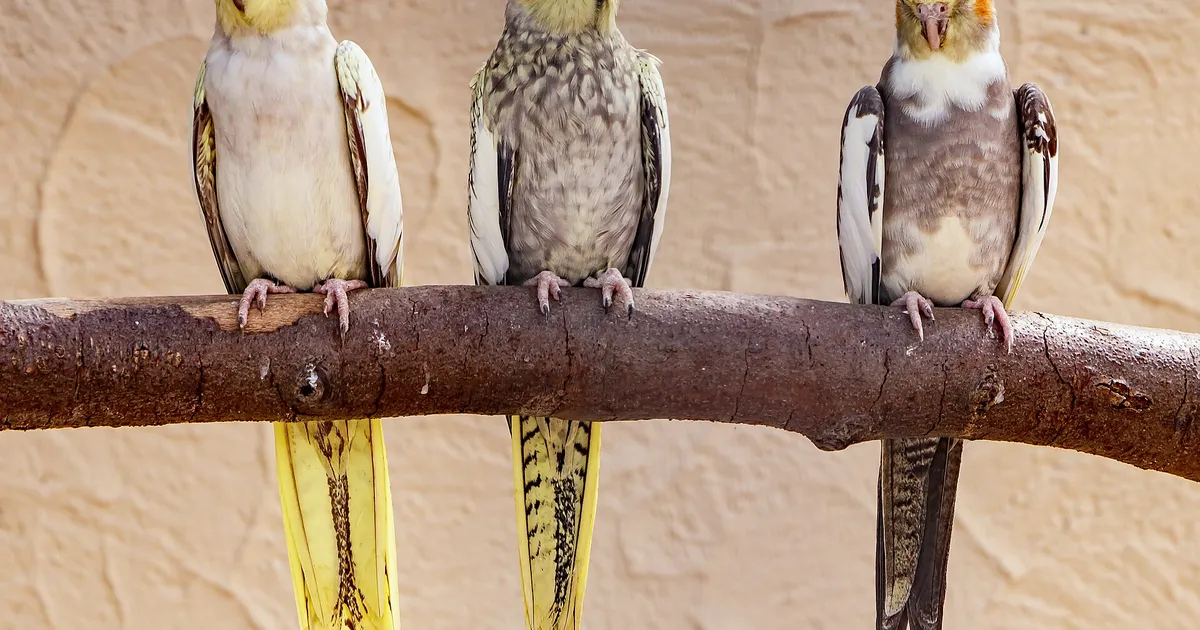
Those two are: (1) some "colours" are not a single gene but two mutations stacked on top of each other (albino, for instance); and (2) in the cockatiel a mutation sometimes hides sex and sometimes reveals it — because the wild bird itself already carries a male–female difference.
The Starting Point: Wild Grey and the Sex Difference
The budgerigar's wild colour was green; the cockatiel's is grey. But unlike the budgerigar, wild grey already carries a visible sex difference — and you must know it to understand the mutations:
- Cock (adult): bright yellow face, vivid orange cheek; the barring under the tail is lost
- Hen: a paler yellow face, a duller orange cheek; the yellow barring under the tail and the yellow spots under the wing remain
So you can tell the sex of a pure grey cockatiel by looking. As you will see below, some mutations erase this difference and make sexing impossible; others, on the contrary, create a new clue to sex.
Cockatiel Mutations by the Three Rules
We explained how the inheritance rules work in our budgerigar mutations article (recessive = the gene must come from both parents; dominant = one copy is enough; sex-linked = on the sex chromosome). The cockatiel's main mutations fall into the three groups like this:
| Inheritance | Mutations |
|---|---|
| Sex-linked | Lutino, pearl, cinnamon, yellowcheek, platinum |
| Recessive | Pied, whiteface, fallow, recessive silver |
| Dominant | Dominant silver, dominant yellowcheek |
Twist 1: "Albino" Is Actually Two Mutations
This is the most instructive point in cockatiel genetics. Birds have two sources of colour (as in the budgerigar article): melanin (grey/dark) and psittacofulvin (yellow/orange). In the cockatiel two separate mutations remove these two sources separately:
- Lutino (sex-linked): removes the melanin → the grey goes, leaving the yellow face + orange cheek, with red eyes
- Whiteface (recessive): removes the psittacofulvin → the yellow and orange go, leaving grey + white
Now stack the two: no melanin and no yellow/orange → what remains is an all-white, red-eyed bird. That is the "albino cockatiel": not a gene of its own, but the whiteface + lutino combination.
This is why so many cockatiel "colours" are really two or three genes piled up: whiteface pearl, whiteface cinnamon pied, albino (whiteface lutino)… To produce a combination you must satisfy the inheritance rule of each gene separately.
Whiteface: Erasing Yellow and Orange
Whiteface is a recessive mutation that removes all of the psittacofulvin pigment. The result: no yellow face, no orange cheek — only a grey body and a white face. It is the cockatiel's counterpart to the budgerigar's blue series (which also removed yellow, turning the bird blue), except here removing it takes the orange cheek with it.
Twist 2: A Mutation Both Hides and Reveals Sex
We said you can read a wild grey's sex from its face. Mutations change that picture in two directions:
The ones that hide it
Mutations such as lutino, whiteface and pied erase the yellow-face/orange-cheek difference, so you cannot tell the bird's sex by looking. Then you rely on behaviour (the cock sings/whistles), on the moult, or on a DNA test.
The one that reveals it: pearl
The pearl mutation gives the feathers a scalloped, lacy pattern — and it has a surprising, cockatiel-specific trait: cocks lose the pearl pattern after their first adult moult and revert to near-plain grey, while hens keep the pearling for life.
So in a pearl cockatiel: if the pattern fades as the bird grows up it is a cock; if the pattern stays it is a hen. This is the cockatiel's own version of the budgerigar's "read sex from colour with a sex-linked mutation" trick.
The sex-linked breeding rule
The sex-linked rule we set out for the budgerigar works identically here: in a pairing of a COCK showing a sex-linked mutation (lutino, pearl, cinnamon) × a normal HEN, all daughters show the mutation and the sons look normal but carry it. You can find the full logic in our budgerigar mutations article; the ZW sex system in birds (cock ZZ, hen ZW) is the same in both species. For the chicken equivalent, see our how to sex chicks article.
The Bald Spot in Lutinos
Lutino cockatiels often show a small bare patch behind the crest. It is not a disease but an inherited trait tied to the lutino line. To shrink it in breeding, one selects and pairs birds whose bald spot is not pronounced — heavy inbreeding can enlarge the fault.
Which Mutations for Beginners?
- Pied (recessive): a clean recessive example; the same logic as the budgerigar's blue series.
- Lutino or pearl (sex-linked): you get to see the read-sex-from-colour/pattern trick.
- Whiteface (recessive): it shows how the psittacofulvin is removed, and how, combined with lutino, it produces the albino.
You will find the incubation and nesting process in our cage-bird incubation article, and the logic of breeding selection and pedigree in our cage-bird breeding article. To keep the mating–laying–hatch calendar straight, the Kuluçka Takip app sets reminders. You can take a look at the app here.
Reading this side by side with the first article in the series, budgerigar colour mutations, lets you see how the three inheritance rules play out across two different species.
Frequently Asked Questions
How many colour mutations does the cockatiel have, and which are the most common?
There are many mutations derived from wild grey. The most common are lutino, pearl, cinnamon, pied, whiteface and their combinations (for example albino = whiteface + lutino). All of them follow one of three inheritance rules: sex-linked, recessive or dominant.
What colour is the natural (wild) cockatiel, and is there a sex difference?
The wild colour is grey and carries a visible sex difference: an adult cock has a bright yellow face and vivid orange cheek and loses the barring under the tail; a hen has a paler face and keeps the yellow barring under the tail and yellow spots under the wing. So a pure grey bird can be sexed by looking.
Is the albino cockatiel a real mutation?
No, it is not a single gene. Albino is actually the combination of two mutations: whiteface (which removes the yellow/orange psittacofulvin) plus lutino (which removes the grey melanin). Together they leave an all-white, red-eyed bird.
What is the whiteface mutation?
Whiteface is a recessive mutation that removes all of the yellow-orange pigment (psittacofulvin). So the yellow face and orange cheek disappear, leaving a grey body and a white face. It is the cockatiel counterpart of the budgerigar's blue series.
What is the difference between cocks and hens in the pearl mutation?
Pearl gives the feathers a lacy pattern. Uniquely to the cockatiel, cocks lose this pattern after their first adult moult and revert to plain grey, while hens keep the pearling for life. So in a pearl bird the one that keeps the pattern is a hen and the one that loses it is a cock.
Is the bald spot on a lutino cockatiel's head normal?
Yes — lutinos often show a small bare patch behind the crest, and it is not a disease; it is an inherited trait tied to the lutino line. In breeding it can be reduced by selecting birds whose bald spot is not pronounced; heavy inbreeding enlarges the fault.
Can you tell a cockatiel's sex from its colour?
It depends on the mutation. It is possible in wild grey and some patterns. But mutations like lutino, whiteface and pied erase the yellow-face/orange-cheek difference, so visual sexing fails; then you need behaviour, the moult or a DNA test. Pearl, conversely, gives a clue to sex (see the question above).
Related Articles
Lovebird Colour Mutations: Blue Is Not One Thing (Parblue)
Lovebird (Agapornis) mutations follow the same three inheritance rules but add two new lessons: blue is not a simple 'present/absent' but the parblue series of several alleles at one locus (blue/aqua/turquoise blend), and mixing species produces fertile hybrids that spoil pure lines. Opaline face colour, sex-linked lutino inheritance, the dark factor and sexing.
Budgerigar Colour Mutations: The Genetics and Predicting Chick Colour
We explain the budgerigar's dozens of mutations, all derived from one wild colour (green), through three inheritance rules: recessive (blue series, the 'split' idea), dominant (grey, spangle) and sex-linked (lutino/albino, cinnamon, opaline). Reading sex from colour thanks to the ZW sex chromosome, the dark-factor table, and the health risk of inbreeding for colour.
Canary Colour Mutations: Two Genes That Kill in Double Dose
The canary is bred in three directions: song, colour, shape. Its most striking feature is two lethal dominant genes: dominant white and the crest kill the embryo in double dose — just like the Araucana ear tuft. The white × yellow and crested × plainhead pairing rule, how the red factor came from the red siskin and colour feeding, and sex-linked melanin mutations.