Budgerigar Care and Breeding: The Day-by-Day Calendar
The budgerigar (Melopsittacus undulatus) is the most kept cage bird in the world — a cheap, sociable, talking little Australian parrot that lives 7-10 years when kept well. But being an "easy bird" does not mean it forgives neglect.
This guide covers the budgie's daily care from top to bottom: cage, diet, feathers and nails, common illnesses — and, in its most detailed section, the breeding calendar day by day: laying on alternate days, why the first and last eggs do not hatch together, and the problem that creates in rearing.
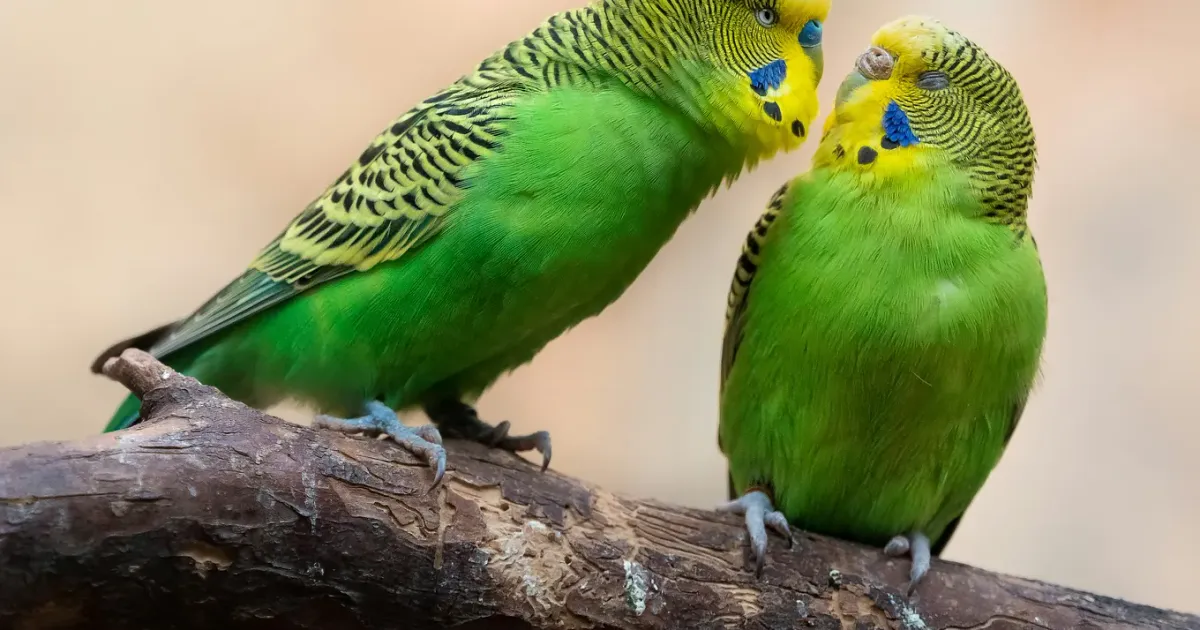
The Basics
| Trait | Value |
|---|---|
| Origin | Australia (the arid interior) |
| Weight | 30-40 g |
| Length | ~18 cm (with the tail) |
| Lifespan | 7-10 years (12-15 when kept well) |
| Sexual maturity | 4-6 months |
| Breeding age | At least 12 months (crucial for the hen) |
| Social structure | A flock bird — unhappy alone |
Being a flock bird is the foundation of its care: the budgie did not evolve to live alone. If you keep one, you become its flock — hours of attention every day. If you can't give that, keep a pair.
The Cage: Horizontal Bars, the Right Perch
- Size: at least 60×40×50 cm for one bird; as large as possible for a pair or more. A budgie flies horizontally, not vertically — width matters more than height.
- Bar orientation: the bars should be horizontal — a budgie climbs, and vertical bars make that hard. Spacing 1.2 cm at most, so the head can't get stuck.
- Perches: the commonest mistake. Plastic, smooth, single-diameter perches ruin foot health (pressure sores, "bumblefoot"). Give natural branches of varying diameter so the foot doesn't grip the same spot forever. Do not use sandpaper perches — they abrade the skin of the foot.
- Placement: at eye level, against a wall (a closed back makes the bird feel safe), no direct sun and no draught, and away from the kitchen — the fumes of a non-stick pan (PTFE) kill a budgie in minutes.
Diet: Seed Alone Is Not Enough
The commonest and most insidious mistake is feeding only a seed mix. Because the budgie is greedy, it picks out only the millet and sunflower and grows fat, goes short of vitamin A and develops a fatty liver.
- Base feed: a good seed mix or pellets. Pellets are more balanced, but a bird unused to them needs a slow transition.
- Fresh greens and veg: a little every day — not iceberg lettuce but dark greens (purslane, spinach leaf, broccoli), carrot, cucumber. Avocado KILLS — never give it.
- A calcium source: keep a cuttlebone in the cage at all times. This is not decoration — it is the main thing that prevents egg binding in the hen.
- Grit: a little mineral grit aids digestion.
- Millet spray: a treat and an occupation, but fattening — now and then, not daily.
- Water: fresh every day; don't let the drinker go slimy.
Light, Bathing and Feather Care
- Light: 10-12 hours of day and 10-12 hours of dark rest. A night cover settles the bird into a rhythm. Constant light (a long day) triggers the breeding hormone and a hen starts laying without stopping — which drains her calcium (below).
- Bathing: a shallow dish or a misting a few times a week. It matters for feather and skin health.
- Nails and beak: usually wear down by themselves with natural perches and a cuttlebone. If they overgrow (the beak overgrows especially with liver trouble), see a vet.
- Moult: a few times a year; the bird is grumpy then, and you can add protein (egg food).
Sexing: The Cere
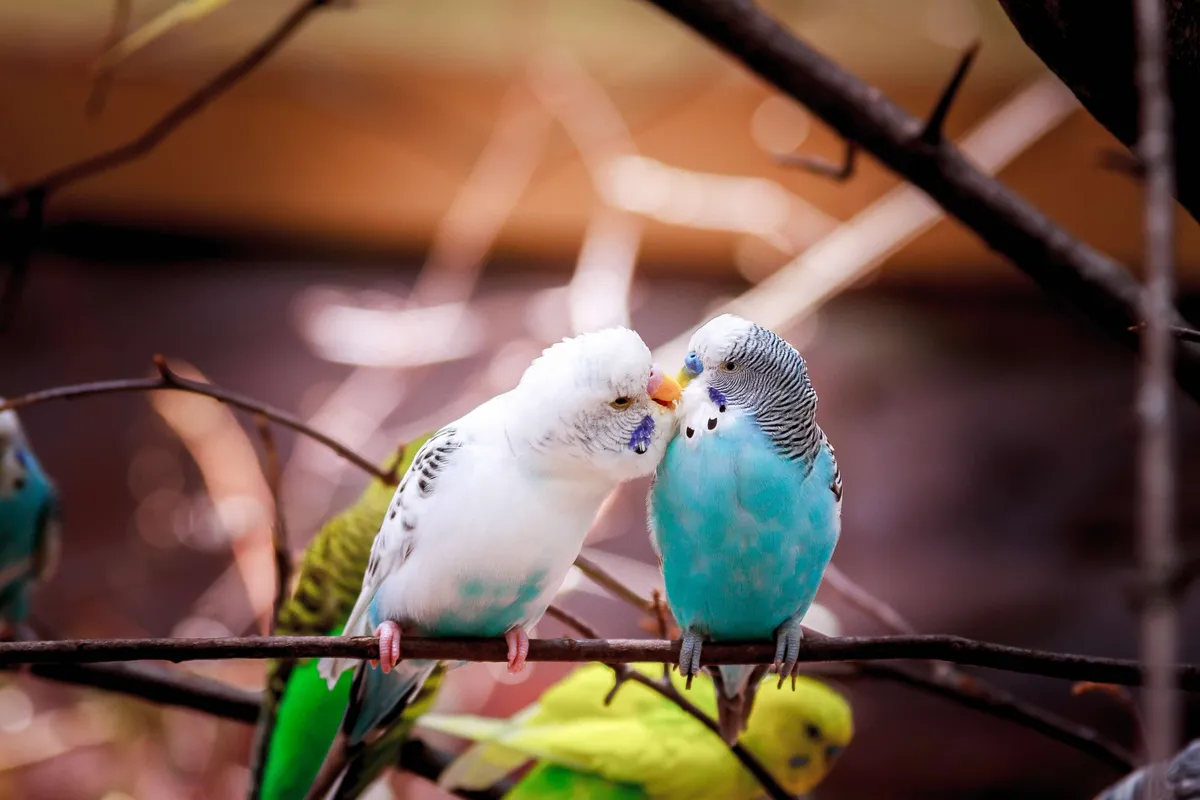
The fleshy skin above the beak is the cere, and in an adult its colour tells the sex:
- Male: the cere is blue or deep purple, smooth and shiny
- Female: the cere is beige or pale blue-white; in breeding condition it turns brown and crusty (it thickens)
A warning: the test is unreliable before four to six months. And in mutations such as lutino, albino, ino and recessive pied the male's cere also stays pink or mauve and the method fails — in those birds sex shows only from behaviour or a DNA test. For the methods in other cage birds, see our cage-bird breeding guide.
The Breeding Calendar, Day by Day
This is the heart of the guide. Breeding a budgie is not the chicken's "collect the eggs, put them in a machine." It runs day by day, and the fact that the eggs are laid on alternate days decides everything.
Getting ready
- The pair must be at least 12 months old (a hen exhausts her calcium if bred too young)
- Healthy, rested, well-fed; and be sure of the sex (two hens will both enter the box, but the eggs won't be fertile)
- The nest box: wooden, closed, with a concave (dished) floor. On a flat floor the eggs roll apart and the chicks' legs splay outward (splay leg). A pinch of shavings is enough.
- Once the box is hung, the hen goes in and adopts it by gnawing; this can take days to weeks
Laying: every other day
About 8-10 days after mating the hen lays the first egg. Each further egg comes at a one-day interval (every other day). The calendar of a typical five-egg clutch:
| Day | Event |
|---|---|
| Day 0 | 1st egg laid — the hen starts incubating at once |
| Day 2 | 2nd egg |
| Day 4 | 3rd egg |
| Day 6 | 4th egg |
| Day 8 | 5th (last) egg |
The critical point: the hen sits from the first egg (some hens wait for the second). So each egg begins to be warmed the moment it is laid — which means the hatches, too, come in the same order, on alternate days.
Incubation: 18 days — but counted per egg
Budgie incubation is 18 days (counted from when the egg starts being warmed). Since the first egg begins warming on day 0:
| Egg | Laid | Hatches (≈18 days later) |
|---|---|---|
| 1st | Day 0 | Day 18 |
| 2nd | Day 2 | Day 20 |
| 3rd | Day 4 | Day 22 |
| 4th | Day 6 | Day 24 |
| 5th | Day 8 | Day 26 |
The rule is simple: each chick hatches about two days after the one before it. So the more eggs the hen lays, the wider the gap between the first and last chick — from a few days to a couple of weeks.
Why does the gap matter? The staggered-hatch problem
When the last egg hatches, the biggest chick is days older and much larger. The nest holds, at the same moment, a chick already growing feathers and a newly hatched naked one. The consequences:
- The smallest chick can be crushed — squashed under its big siblings
- It falls behind on food — the parents feed the one that begs most (the biggest, loudest), and the smallest can starve
- This is the commonest loss in cage-bird breeding — the last-hatched chick is often the one lost
What to do?
- Check the nest briefly once a day; look at whether the smallest chick has food in its crop (an empty crop means it is going hungry)
- You can foster a starving smallest chick into another pair's nest with chicks of a similar age — budgies usually accept a stranger's young
- The last resort is hand-feeding, but it is laborious and risky
Candling: is it fertile?
The eggs are small and pale-shelled, so candling is easier than with a hen — but they are fragile: don't pick them up; look at them in the nest with a torch.
- At day 5-7 a fertile egg shows a web of veins and a dark spot (the embryo)
- An empty (infertile) egg stays clear; don't remove it early and disturb the hen's sitting — you can take it out toward the end
- If fertility is low: a pair too young or too old, two hens (see sexing), slipping perches (the pair loses balance mating — a firm perch is essential), a short daylight. More in our fertility guide.
Chick development and fledging
| Age | Development |
|---|---|
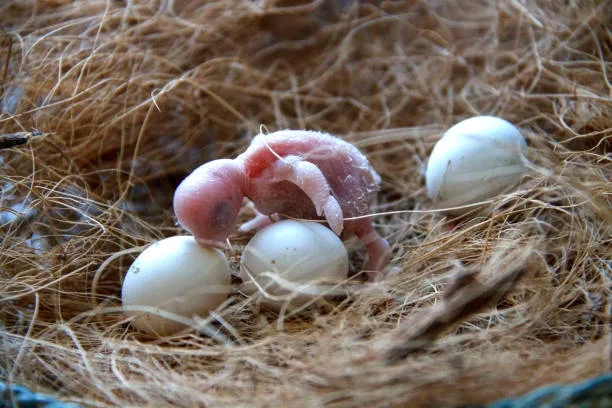
| 0-7 days | Naked, blind; only the parents feed it (crop milk plus ground feed) |
| ~7 days | The eyes open |
| ~10 days | Feather sheaths appear |
| 3-4 weeks | Feathers in, colour set |
| ~30-35 days | Leaves the nest (fledges) |
| ~6 weeks | Eats on its own; can be separated from the parents |
The Limit: Two Clutches a Year
A budgie can lay without stopping — but that kills the hen. Every clutch empties her calcium and energy stores. The rule:
- At most two clutches a year, three only exceptionally. Rest the hen between them (take the nest box away)
- If the hen keeps laying (even without a box): cut the light (bring the day down to 8-10 hours), stop the fatty feed, keep the cuttlebone in place
- A chronically laying hen is the one most at risk of egg binding — she needs veterinary follow-up
Common Illnesses
- Egg binding: the number-one killer of hens. The bird fluffs up, sits on the floor and strains. Warm her (28-30 °C) and get her to a vet at once; don't push the egg yourself. Prevention: constant calcium. Detail in our cage-bird breeding guide.
- Scaly face mite (Knemidokoptes): a honeycomb-like crust around the beak and cere. It is contagious; a vet treats it with ivermectin.
- Megabacteria (going light): the bird eats a lot but loses weight and vomits. A digestive fungal/bacterial problem; it needs a vet.
- Tumours: budgies are prone to them with age (especially of the kidney or testis) — a limp or a swollen abdomen is a sign.
- PTFE poisoning: the fumes from an overheated non-stick pan kill in minutes. Don't keep the bird in the kitchen.
Quarantine and Hygiene
- Keep a new bird in separate quarantine for 30 days before adding it to your existing birds
- Clean the drinker and feeder every day; mouldy feed kills
- Clean the nest box after every clutch; mites and lice build up in it (the biosecurity logic)
In Summary
- It is a flock bird — keep a pair, or be the flock yourself (daily attention)
- Seed alone kills — pellets or veg, and a cuttlebone at all times
- The eggs come on alternate days — so do the chicks; each hatches about two days after the last, so the more eggs, the wider the first–last gap
- Watch the smallest chick — the staggered hatch can leave it hungry
- No more than two clutches a year — it exhausts the hen and leads to egg binding
Frequently Asked Questions
How many days until budgie eggs hatch?
Incubation is 18 days, but counted from when each egg starts being warmed. Because the eggs are laid on alternate days and the hen sits from the first egg, the chicks also hatch on alternate days: each chick hatches about two days after the one before it. So the more eggs the hen lays, the wider the gap between the first and last chick.
Why does a budgie lay every other day?
It is the species’ natural pattern. The hen lays each egg at a one-day interval (day 0, 2, 4, 6, 8). Because she incubates from the first egg, the eggs are warmed in the order they were laid and hatch in the same order, on alternate days. The result is a nest with big and small chicks at once.
Why does the smallest chick die?
Because of the staggered hatch. When the last egg hatches, the biggest chick is already days older and much larger; the smallest is crushed or falls behind on food (the parents feed the biggest, loudest beggar). Check the nest once a day and look at whether the smallest chick has food in its crop; if it is starving, foster it into another pair’s nest with chicks of a similar age.
How do you tell a male budgie from a female?
By the cere, the skin above the beak: in an adult male it is blue or deep purple; in a female, beige to brown (turning brown and crusty in breeding condition). But it is unreliable before four to six months, and in mutations like lutino and albino the male’s cere stays pink, so the method fails; those birds need a DNA test.
How many times a year should a budgie breed?
At most two clutches (three only exceptionally). Each clutch empties the hen’s calcium and energy stores; more leads to egg binding and death. Take the nest box away between clutches to rest her. If she keeps laying, bring the daylight down to 8-10 hours.
Can a budgie live on seed alone?
No — that is the commonest fatal mistake. The bird picks out only millet and sunflower, grows fat and develops vitamin A deficiency and a fatty liver. Add pellets, dark green veg and a cuttlebone at all times to the seed mix. Avocado kills — never give it.
Can I keep a budgie in the kitchen?
No. The invisible fumes from an overheated non-stick pan (PTFE) kill a budgie in minutes. Put the cage away from the kitchen, out of draughts and direct sun, at eye level with its back to a wall.
Related Articles
Quail Farming: Housing, Feed, Eggs and Care Guide
How to farm quail: cage housing, high-protein feed, laying onset at 6-8 weeks, sexing, chick care and hygiene — a quail-keeping guide from scratch.
Breeding Cage Birds: Budgies, Canaries, Cockatiels and Lovebirds
Cage-bird chicks hatch naked and blind (altricial): an incubator will hatch the egg, but you cannot feed what comes out. The incubation of all four species, four different ways to sex them (the cere in budgies; in canaries the one that sings is the male; in cockatiel mutations only DNA works), why breeding too young and egg binding kill, and the lethal gene in the dominant white canary.
How Does a Budgie Talk? How to Teach It Words
Pound for pound the budgie is the world's best talking bird (record: 1,728 words). The factors that decide talking (cock, single, young, hand-tame), mimicry with the syrinx plus context learning, teaching words before whistles, the mirror problem, the 'warble' sign, sexing by the cere (and how mutations spoil it), and the welfare balance around loneliness for the sake of talking.