What Is Candling? A Day-by-Day Guide to What You See Inside the Egg
Candling is the most practical way to see how incubation is going: in a dark room you hold a strong light under the egg to see inside and tell whether it's fertile and whether the embryo is developing. In this guide we explain how and when to candle, what you see inside the egg day by day, and how to interpret it, with schematic illustrations. For the general process, also see our guide to hatching eggs in an incubator.
What Is Candling?
Candling means passing light through the eggshell to reveal the structures inside (the air cell, the network of veins, the embryo). The name comes from the old use of a candle's light; today a strong LED torch or a candling lamp is used. The goal is twofold: to cull infertile and dead eggs, and to track development.
How Is It Done?
- Darken the room. Hold the egg's blunt (wide) end to the light; the air cell is there.
- Use a cold light (LED) so it doesn't heat the egg. Keep it brief (a few seconds per egg) so the egg doesn't cool.
- Keep your hands clean; hold the egg gently and don't shake it. Put it back in the machine quickly when done.
- The image is clear on light-coloured shells; it's harder on dark/speckled shells (like quail).
When Is It Done?
For chickens it's usually done on days 7, 14 and 18. The first check shows fertility, the second development, the third (before lockdown) the final state. It's done earlier in short-period species (quail ~day 7) and later in long ones (goose/duck on days 7, 14 and 25-27).
What Do You See Inside the Egg, Day by Day?
The descriptions below are for chickens (the images are schematic illustrations):
- Days 1–4: Nothing clear yet; only the air cell at the blunt end is visible. Candling is too early at this stage.
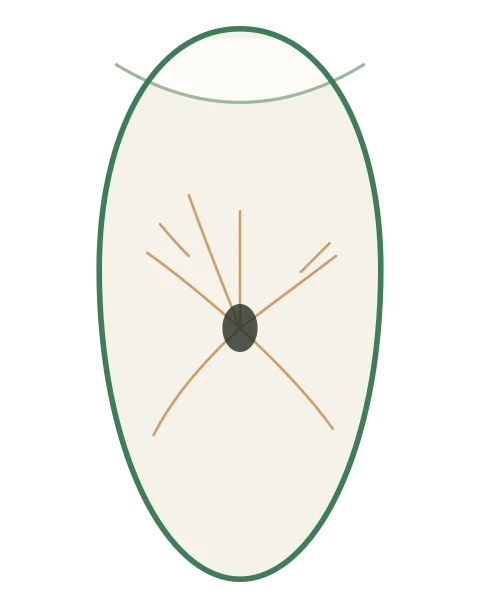
- Day 7: A small dark spot in the centre (the developing embryo, the "eye") and a spider-web of veins spreading out from it. If you tilt the egg gently, you may notice the embryo move. This is the clearest sign of a fertile, living embryo.
- Day 14: The embryo has grown and most of the egg has darkened. The air cell at the blunt end becomes clear; a thin bright area still remains towards the pointed end.
- Day 18: The egg is almost fully dark; only the growing air cell lets light through. The air cell's edge looks "drawn down" on one side — the chick is getting ready to break the inner membrane (internal pip). This is lockdown and final-check time.


What to Look For: Fertile, Infertile and Dead
The main benefit of candling is culling problem eggs early:
- Infertile (clear): If on day 7 it's still completely clear with only a faint yolk shadow inside, the egg is infertile. The problem isn't the incubation but the breeding stock; remove this egg.
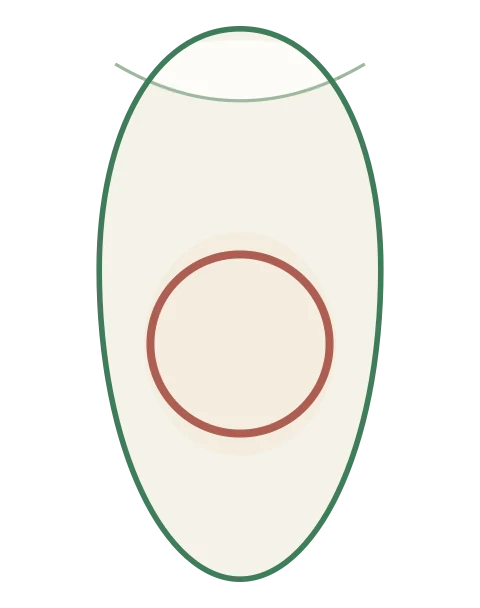
- Blood ring (early death): A red ring near the shell shows an embryo that started developing and died early. It's usually a temperature or storage issue; remove this egg too.
- Late death: An egg that developed earlier but later went still, looking dark but irregular. If it smells bad, definitely remove it; it can spoil and burst inside.

Species Differences
Candling is easy on a light chicken egg. On speckled, dark-shelled eggs like quail it's very hard to see inside; with these species you often have to wait until hatch. Goose and duck eggs are large and thick-shelled; they need a stronger light and a dark room. For very thick-shelled eggs like ostrich, special methods (weight tracking) are used.
Tips and Common Mistakes
- Don't throw out a suspect egg right away; wait until the next candling to be sure. Development sometimes starts slowly.
- Don't heat or cool the egg by holding it in the light/your hand too long.
- Candling too often opens the lid unnecessarily and loses heat/humidity; do it on the set days.
- After day 18 (lockdown) don't touch the eggs; any handling, including candling, is risky.
Tracking candling days and what follows (lockdown, raising humidity, hatch) can get confusing. The Kuluçka Takip app automatically calculates and reminds you of candling, lockdown and hatch days for your species. You can check out the app here.
Candling turns incubation from a "blind" routine into something you manage by observation. Done regularly and carefully, it both culls empty eggs and gives invaluable experience for the next batch. For the basic principles, see our chicken incubation guide.
Frequently Asked Questions
What is candling?
It's holding a strong light under the egg in a dark room to see inside. It lets you tell whether the egg is fertile and track the embryo's development.
When is candling done?
For chickens, usually on days 7, 14 and 18. The first check shows fertility, the last one (before lockdown) shows the final state.
What do you see on day 7?
A dark embryo spot in the centre and a spider-web of veins spreading from it; movement may be noticed when the egg is tilted. This is the sign of fertile development.
How do I tell an egg is infertile?
If on day 7 it's still completely clear with no network of veins, the egg is infertile. The problem isn't the incubation but the breeding stock.
What does a blood ring mean?
A red ring near the shell shows an embryo that started developing and died early; usually a temperature or storage issue. Remove this egg.
Does candling harm the egg?
Not when done correctly. Use a cold LED light, keep it brief, don't heat or cool the egg, and don't touch it after day 18 (lockdown).